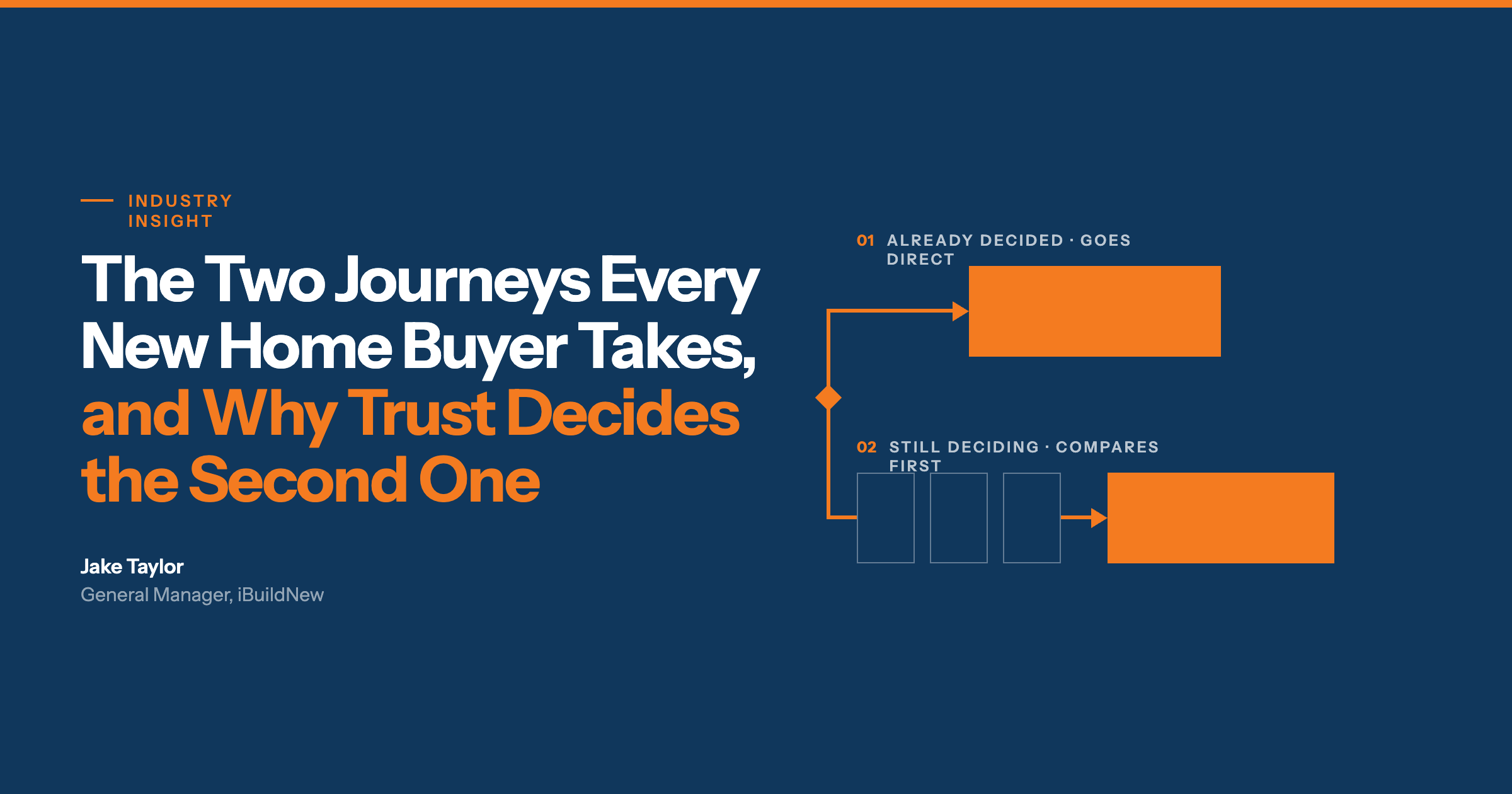
Every new home buyer moves through the market in one of two ways. Some already know who they want to build with. Others are still working out who that will be. These two groups behave completely differently online, and they need different things from wherever they land.
Some buyers have already made their decision, or narrowed it down close enough that they're ready to move forward. They search a builder's name directly, click through from a referral, or come back to a website after visiting a display home in person. This is a confident, direct journey. They're not comparing anymore, they're progressing.
Naturally, this buyer goes straight to that builder's or estate's own website. There's nothing to discover. They already know where they're headed.
Before a buyer reaches that point, most go through a much harder phase: working out what they can actually afford, comparing floor plans, lot sizes, packages, or figuring out which area even fits their budget and lifestyle.
This buyer isn't trying to find a specific company. They're trying to solve a different problem entirely: how do I compare my options fairly, understand what's realistic for my budget, and feel confident enough to have a real conversation with someone.
This is where a portal does its job. Its purpose isn't to capture people who couldn't find a builder's website. It's to give buyers who are still comparing a place to see multiple options side by side, understand pricing and inclusions, and work through the decision at their own pace, before they're ready to commit to a conversation with a builder/estate.
Price and inclusions are the obvious things a buyer lines up side by side, but they're rarely the whole picture. Over the past few years, mainstream media has run a steady news cycle around builders collapsing mid-build, and around developments stalling, with buyers left waiting years longer than promised for land that was meant to be ready sooner. Buyers notice, whichever side of the industry they're dealing with. For a lot of them, choosing who to build with, or which estate to buy into, now carries a genuine question of stability and follow-through, not just value for money.
That question is hard to answer with a company's own marketing. A builder or developer can say they're reliable, but a buyer has no easy way to tell whether that's a fair claim or just a well-written one, because it's the company talking about itself. What actually moves the needle is something independent of the company: editorial coverage, genuine success stories, and content written or verified by someone other than the business being assessed.
This is the real value a third-party brand brings to a builder's or developer's marketing mix. It isn't a substitute for direct, branded messaging, and it isn't trying to be. It's the piece that direct messaging structurally can't provide on its own, because trust built by a company about itself will always read differently to trust built by an independent source telling the same story.
A builder's or estate's own website is built to serve someone who has already chosen them. A portal is built to help someone work through the choice in the first place, price and inclusions alongside the harder-to-quantify question of who they can trust to actually deliver. These aren't different sizes of the same audience, they're different jobs, done at different stages of the same buyer's journey.
A buyer arriving through a portal is often still forming their shortlist, and weighing up more than the numbers on a quote. They need more education and more reassurance than someone who already chose a builder, and increasingly that reassurance needs to come from somewhere other than the builder itself. That first conversation looks different: less "which colour scheme," more "help me understand if this is the right fit, and if you'll still be here to finish it." iBuildNew provides a third party tone of voice to complement considerations along side builders own campaigns activity.
The same pattern shows up for estates, with a different set of questions attached. A buyer might already know they want to build new, and even have a rough budget, without knowing which estate or lots sizes, or which developer has a track record of actually delivering the community they're promising. Third-party tone of voice supports the buyers researching an estate want to see it discussed and reviewed in addition to the developer's messaging.
Buyers who already know where they're headed and buyers who are still deciding aren't the same audience wearing different hats. They're solving two different problems, at two different points in the journey, and increasingly, the second group is solving a trust problem as much as a price one. A strategy that only accounts for the buyer who already decided may miss the ability to earn the one still deciding, at the exact moment they're working out who to trust.
.jpg)
.png)
.png)
.png)
.png)