
The Property Council of Australia's national housing conference in Melbourne brought together major developers, regulators, and federal government to talk about the state of residential construction in 2026. The line-up was developer-heavy and policy-heavy, which means home builders weren't the audience the panels were directly addressing. However, the conversations are as relevant to a residential builder as to anyone in the room.

Stockland chief executive Tarun Gupta warned that residential development is heading for a "major, major slowdown" unless fiscal and monetary policy work together. His underlying point is the one that matters for our audience. Buyers no longer have the capacity to absorb input cost increases the way they did during the post-COVID period. If costs cannot be passed through, projects don't proceed, and builders don't build.
That isn't a developer-only concern. It's the demand-side mechanism every home builder relies on. Anyone running fixed-price contracts into the back half of 2026 should be modelling this scenario, not last cycle's.
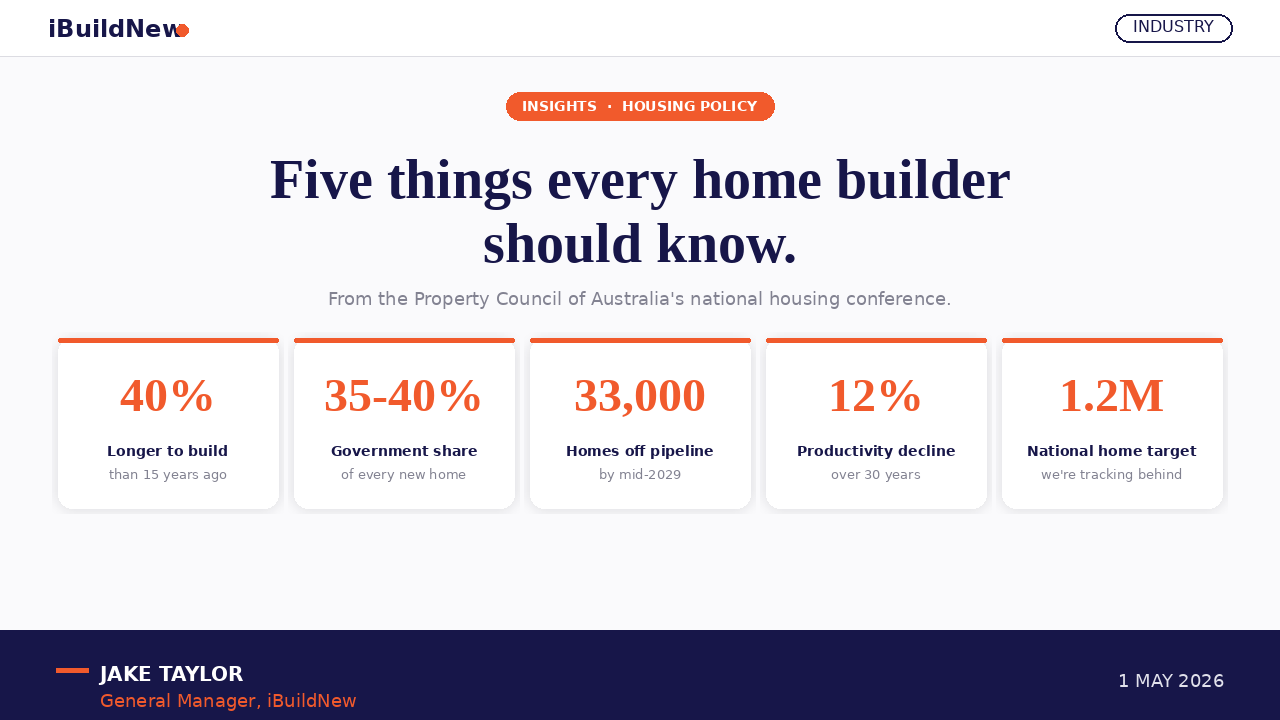
Mirvac chief executive Campbell Hanan estimated that between 35 and 40 per cent of the cost of a new house or apartment is some form of government contribution, levy, or tax. That is a major developer publicly stating that close to half the price of every new home is paid before a single trade swings a hammer.
For home builders, this figure does two things. It validates what the industry has been saying privately for years, and it gives the affordability conversation a concrete anchor. Anyone preparing submissions, media talking points, or client conversations on the cost of new homes should be using this number.

Productivity Commission chair Danielle Wood pointed out that houses, townhouses, and apartments now take roughly 40 per cent longer to build than they did 15 years ago. After adjusting for the fact that homes are bigger and built to higher standards, residential construction productivity has still fallen by about 12 per cent over 30 years.
For builders, the takeaway is that the productivity decline isn't a labour problem, a workmanship problem, or a generational problem. It's a process and compliance problem. The Productivity Commission has now put its name on it. That changes what the policy conversation can look like from here.
The most consequential statement of the day came from federal Housing Minister Clare O'Neil, who committed to simplifying the National Construction Code, with a public report due later this year. The work will include reducing state-by-state variation in how the code is applied, and tightening governance around how future code changes are made.
That governance piece is the one to watch. The current NCC model, by O'Neil's own admission, has incentives that lean toward adding requirements rather than removing them. Anyone who has tried to reconcile a Victorian Section J calculation against a New South Wales BASIX outcome will recognise the cost of that drift. Home builders should be tracking the consultation process when it opens, and contributing where they can.

Worth noting what was largely missing from the panels and the public commentary: the day-to-day operating pressure on Australia's home builders. Major developers and federal government were well represented. The Productivity Commission's data was national in scope. But the volume builder facing a fixed-price contract that no longer stacks up, the regional builder navigating a state-specific compliance requirement that adds three weeks to a build, the smaller operator quietly closing because the maths no longer works, that conversation didn't make the page.
Four threads worth tracking through the rest of 2026:
If those threads start to weave together, the next 12 months could be a genuine inflection point for residential construction reform. If they don't, the slowdown set out at the conference is the one builders will be quietly absorbing through the second half of the year, while the public conversation moves on.
The conference put on the public record what builders have been saying privately for some time. The numbers are in print. The ministerial commitment is at the table.
.jpg)

